Novel · sneak peek
BURN
A novel
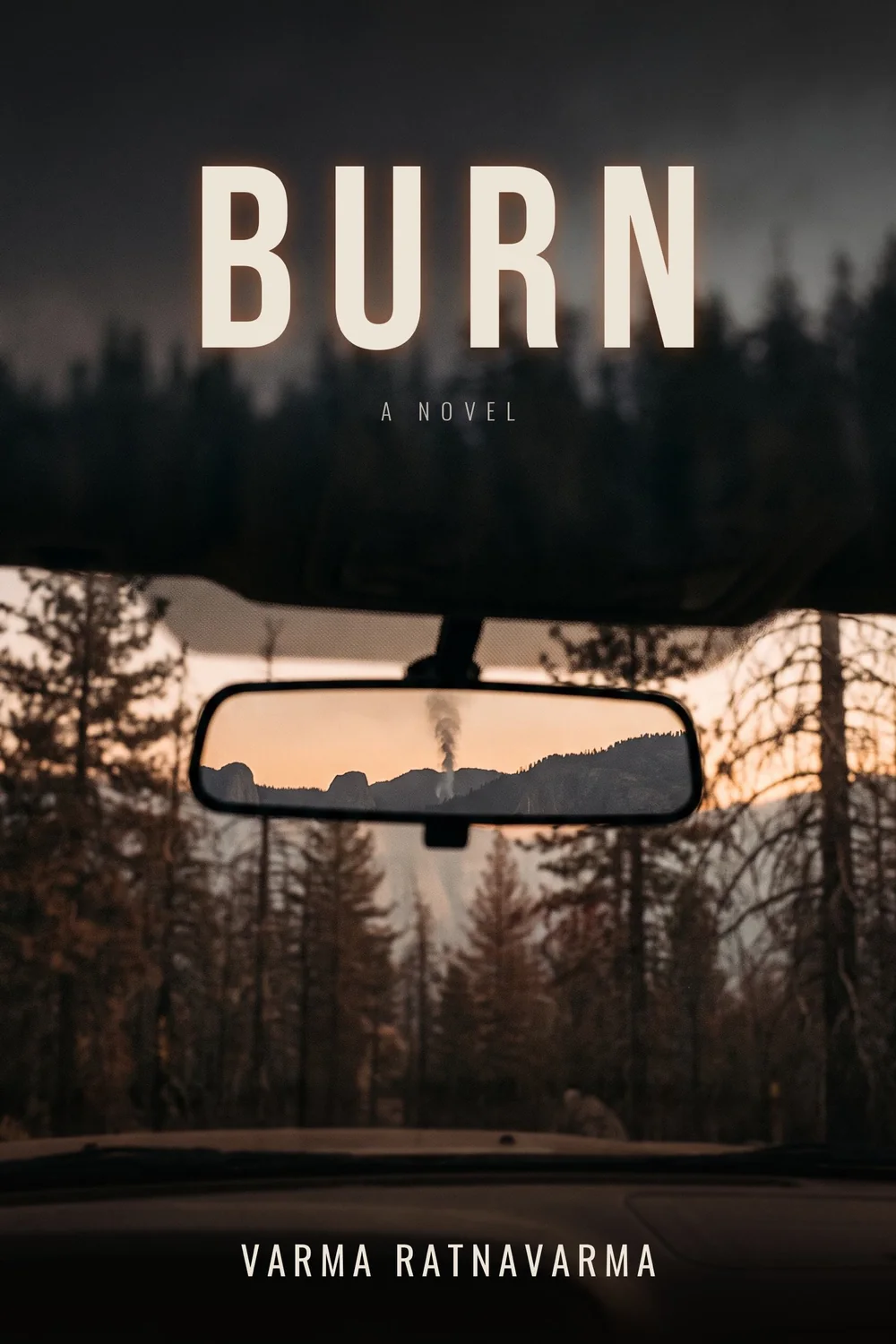
A fire takes a foothill town. A father is blamed. In prison, a crew of broken men builds a model of fire by hand.
Jason Charm is good in rooms. He says the right thing at the right moment. At home he says it half a second late. His wife has counted those half-seconds for years.
The family camps in the Sierra foothills. On the last morning Jason has a launch call in forty minutes. By that afternoon a fire has reached the town of Larkin. Eleven people die. Four days later a kind investigator brings him coffee and a map. Then he asks Jason to take his time.
Investigators think the fire started near the family’s campsite. Everyone thinks they know what happened. The fire keeps no record of its own.
What it is about
Feeling and its absence
BURN runs on human feeling and on its absence. Jason feels things late, or somewhere else, or not at all.
The book follows that gap as it closes. It closes slowly. It costs him. It never closes all the way.
The people
Good people in bad situations
Nobody in BURN is a villain. Nobody is a saint. Each main character does a good thing for a bad reason. Each does a bad thing for a good one.
A bored guard. A con man. An old firefighter who set fires to keep his crew paid. Each of them surprises you. Pressure brings out the best in people who had stopped expecting it of themselves.
What is important
What matters when everything burns
- Being present for the people in the room
- How you treat the weaker person
- A letter written every Sunday to a daughter
- Showing up again the next day, with no promise of forgiveness
The philosophy underneath
Nature keeps no ledger
Justice is a human invention. The book asks where luck ends and guilt begins.
A man in the bunk below prays every night. He and Jason argue about God. The book never settles that argument. It leaves the questions with the reader.
The world model at the core
The machine in this book is made of men.
Jason cannot see the forest from a prison cell. So he carries a picture of the land in his head. He runs it forward. He asks it what happens next.
That is a world model. The book never uses the term. It shows one being built.
The men build it by hand. Each man holds a strip of the forest in a commissary notebook. Each cell holds fuel, moisture, slope and burn state. At count time each man passes his edge values to his neighbours. Every strip runs twice. When two men disagree, the old firefighter settles it. He catches values that fire would never produce. He cannot say how he knows.
- Fuel what there is to burn
- Moisture how wet it is
- Slope fire runs uphill fast
- Burn state unburned, burning or out
Why it matters now
Look it up, or run it forward
The science is real. A reader can follow it step by step.
The central argument is one I work on every day. Do you look up what happened before? Or do you simulate forward where no record exists? The tables say one thing. A man who has smelled the wind says another. The book shows what that choice costs.
Today the same idea runs inside AI systems. An agent that plans ahead needs a model of the world it can run forward and question. BURN puts that idea in human hands. Pencil, graph paper and lives on the line.
Where it stands
A novel in progress
About 75,000 words in four movements. Larkin, Cielo Alto and every person in the book are invented.
Excerpt
From chapter one, The Picnic
The meadow was the only green thing for twenty miles, and Elena had chosen it for exactly that reason.
She had found it on a paper map two winters earlier, a thumbprint of blue-green in a sheet of brown contour lines, fed by a spring the map called Bitterwater. Within an hour of arriving the children had renamed it Butterwater, because Leo could not say the real word without making it sound like a punishment. Around the meadow the Cielo Alto hills were the colour of a lion in August. Inside it the grass came up to Maya’s knees and was cold at the roots.
Jason was being wonderful.
That was the word Elena would use later, to the investigator, and she would watch him write it down and underline it, as if wonderful were evidence. It was. She had been married to Jason Charm for eleven years, and she knew the exact weight of the word.
A short excerpt from the manuscript in revision. Wording may change before publication.
The author
Varma Ratnavarma
Varma has 21 years in enterprise technology. He researches world models and agentic AI. BURN puts that work in human hands.
Read alongside
 Agents with Foresight World Models for Reliable Action in Digital Enterprises The technical side of the same question. When does an agent need a model of its world?